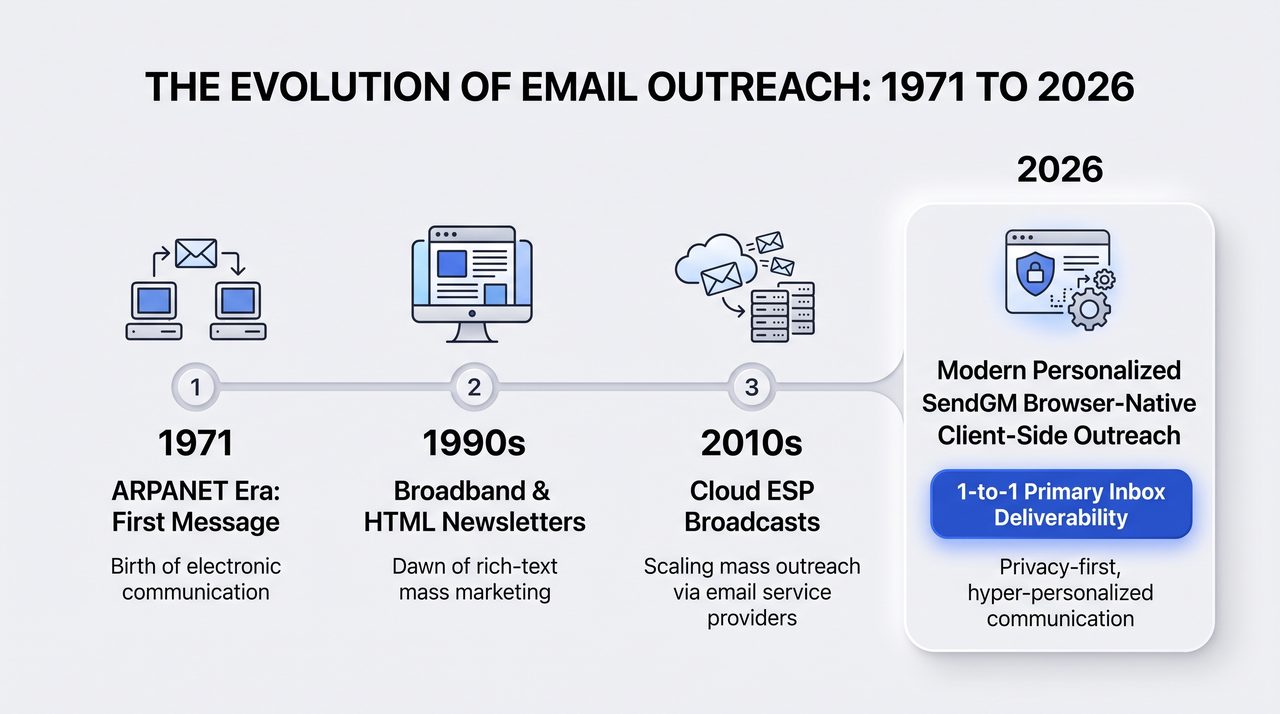
Email has evolved from a primitive network experiment connecting mainframe computers into the backbone of global commerce, generating over $10 billion in annual marketing value. Over the past five decades, email communication has transitioned through distinct eras: from experimental ARPANET text messages to unsolicited mass blasts, through the golden age of graphical newsletters, and finally to modern, privacy-first, client-side outreach workflows.
Understanding this evolutionary trajectory reveals why massive broadcast blasts are fading and why authentic, personalized 1-to-1 outreach has reclaimed the primary inbox.
1. Timeline of Email & Outbound Marketing Milestones
| Year | Milestone | Industry Impact |
|---|---|---|
| 1971 | Ray Tomlinson invents network email on ARPANET. | Introduced the @ symbol to separate usernames from machine hostnames. |
| 1978 | Gary Thuerk sends the first mass promotional email. | Generated $13M in sales for DEC computers; birthed commercial email outreach. |
| 1982 | SMTP (Simple Mail Transfer Protocol) standardized (RFC 821). | Created the universal technical protocol for routing electronic mail across the internet. |
| 1996–1997 | Hotmail and Yahoo Mail launch free consumer webmail. | Democratized consumer email access, enabling direct B2C marketing at scale. |
| 1999 | Seth Godin publishes Permission Marketing. | Popularized the opt-in subscriber model over unsolicited bulk mailing. |
| 2003 | CAN-SPAM Act enacted in the United States. | Established legal compliance rules, physical address disclosures, and opt-out penalties. |
| 2004 | Google launches Gmail. | Introduced 1GB storage, thread organization, and machine-learning spam filtering. |
| 2010s | Rise of marketing automation (Mailchimp, HubSpot). | Proliferated rich HTML newsletters, tracking pixels, and automated drip sequences. |
| 2021 | Apple introduces Mail Privacy Protection (MPP). | Cached tracking pixels, rendering automated open-rate metrics unreliable. |
| 2024–Present | Strict Google/Yahoo DMARC mandates & AI filtering. | Accelerated the shift toward authentic, plain-text outreach and browser-native tools like SendGM. |
2. Era 1: The Origin & The $13M Demonstration (1971–1978)
In late 1971, computer engineer Ray Tomlinson developed a system called SNDMSG on TENEX operating systems connected via ARPANET (the precursor to the modern internet). Tomlinson chose the @ symbol to direct messages between specific computers, creating the world’s first network email.
[1971: Ray Tomlinson] ──> "@" syntax created ──> 2 PDP-10 Mainframes linked via ARPANET
[1978: Gary Thuerk]   ──> 393 ARPANET recipients ──> $13M in DECSYSTEM-20 Computer Sales
Seven years later, on May 3, 1978, Gary Thuerk, a marketing manager at Digital Equipment Corporation (DEC), sent an invitation promoting DEC’s new DECSYSTEM-20 computers to approximately 393 users on ARPANET.
The email sparked outrage from network administrators for violating the academic network’s acceptable use policy. However, the campaign yielded $13 million in purchase orders and product demonstrations, demonstrating the unprecedented commercial potential of direct electronic messaging.
3. Era 2: The Webmail Explosion & The Spam Wars (1990s–2003)
The commercialization of the internet in the mid-1990s transformed email from an institutional tool into a ubiquitous consumer medium.
- Free Webmail Access: Platforms like RocketMail, Hotmail (1996), and Yahoo Mail (1997) allowed millions of households to create personal email accounts without dedicated ISP configurations.
- The Bulk Mail Avalanche: Because sending an email carried zero marginal cost, marketers began scraping databases and blasting millions of unauthenticated messages, resulting in inboxes filled with advance-fee scams, counterfeit goods, and unsolicited ads.
- Legislative Guardrails: To counter malicious flooding, the United States passed the CAN-SPAM Act of 2003, establishing mandatory sender identification, non-deceptive subject line standards, and clear unsubscribe mechanisms.
4. Era 3: Marketing Automation & HTML Newsletters (2004–2018)
As email service providers built basic Bayesian spam filters, the marketing industry pivoted from reckless blasting to structured, permission-based marketing automation.
┌─────────────────────────────────────────────────────────────┐
│ Visual WYSIWYG Builders & Multi-Column HTML Newsletters     │
├─────────────────────────────────────────────────────────────┤
│ Automated Drip Workflows & Behavioral Trigger Campaigns     │
├─────────────────────────────────────────────────────────────┤
│ Open & Click Tracking Pixels embedded in Email Footers      │
├─────────────────────────────────────────────────────────────┤
│ Shared Broadcast ESP Infrastructure (Mailchimp, Klaviyo)    │
└─────────────────────────────────────────────────────────────┘
During this era, dedicated Email Service Providers (ESPs) became standard for businesses. Companies sent heavily styled, multi-column HTML newsletters to thousands of opt-in subscribers. However, this model came with drawbacks:
- Promotions Tab Segregation: In 2013, Gmail introduced category tabs, routing promotional HTML templates away from the primary inbox.
- Mounting Software Costs: ESPs began charging escalating monthly subscriptions based strictly on list size, penalizing businesses for inactive contacts.
5. Era 4: The Modern Shift: Plain-Text Deliverability & Privacy (2019–Present)
By the early 2020s, the email landscape underwent two massive shifts: privacy enforcement and anti-spam infrastructure mandates.
1. The Death of Superficial Metrics
With Apple’s Mail Privacy Protection (MPP) pre-fetching tracking pixels in 2021, open-rate metrics on broadcast platforms became inflated and unreliable. Senders had to evaluate campaigns based on real business outcomes: replies, scheduled discovery calls, and closed revenue.
2. Strict Authentication Standards
In 2024, Google and Yahoo enacted strict technical enforcement, requiring bulk senders to configure SPF, DKIM, and DMARC, while capping spam complaint thresholds at 0.30%. Shared marketing IP subnets suffered deliverability penalties as poorly authenticated senders were quarantined.
3. The Return to 1-to-1 Plain-Text Communication
Modern B2B decision-makers increasingly ignore glossy corporate marketing graphics. Plain-text or minimally formatted emails—sent directly from authentic personal or Google Workspace accounts—deliver the highest open rates and conversion figures because they look and feel like genuine human correspondence.
6. How Email Dispatch Architecture Evolved
Generation 1 (1970s–1980s):
[Local Terminal] ──> Direct SMTP Relay ──> Destination Mainframe

Generation 2 (2000s–2010s):
[User CSV Data] ──> Cloud Server Database ──> Shared ESP IP Pool ──> Recipient (Promotions Tab)

Generation 3 (Modern / Present):
[Local CSV in Browser] ──> Client-Side Memory ──> Authenticated Google Session ──> Primary Inbox
Modern browser-native platforms like SendGM represent the newest chapter in this timeline. By processing CSV merge lists locally in browser memory and launching pre-populated compose sessions directly through your active Google account, users eliminate:
- Recurring monthly contact-tier fees ($50–$150+/mo).
- Third-party database security and compliance risks.
- The deliverability penalties associated with shared broadcast IP pools.
Frequently Asked Questions
Who is considered the “Father of Spam”?
Gary Thuerk, a marketing manager for Digital Equipment Corporation (DEC), earned this title after sending the first unsolicited commercial mass email to roughly 400 ARPANET users in May 1978.
Why did marketing emails move away from heavy HTML templates?
Heavy HTML templates, multiple external tracking links, and marketing header scripts signal to modern email algorithms that a message is promotional. Plain-text emails bypass Gmail’s Promotions tab algorithms and mirror organic peer-to-peer conversations, resulting in higher reply rates.
What is the primary difference between legacy ESPs and browser-native mail merge tools?
Legacy ESPs (like Mailchimp) upload your contact lists to remote cloud databases and send messages through shared bulk server IPs. Browser-native tools (like SendGM) parse contact data locally in your browser and route individual emails directly through your authenticated Google session, ensuring total data privacy and primary inbox deliverability.