Artificial Intelligence has permanently lowered the cost of generating written copy. With large language models (LLMs) capable of drafting personalized emails in milliseconds, the volume of outbound messaging has skyrocketed. However, this explosion in outbound volume has triggered an aggressive counter-response: email service providers (ESPs) like Google and Microsoft have deployed advanced machine learning models to detect, classify, and filter synthetic outreach before it ever reaches the recipient.
The future of email marketing is not about blasting thousands of automated AI drafts. It is defined by context-aware personalization, semantic deliverability defense, and human-in-the-loop workflows.
1. The Evolution: From Static Merge Tags to Contextual Synthesis
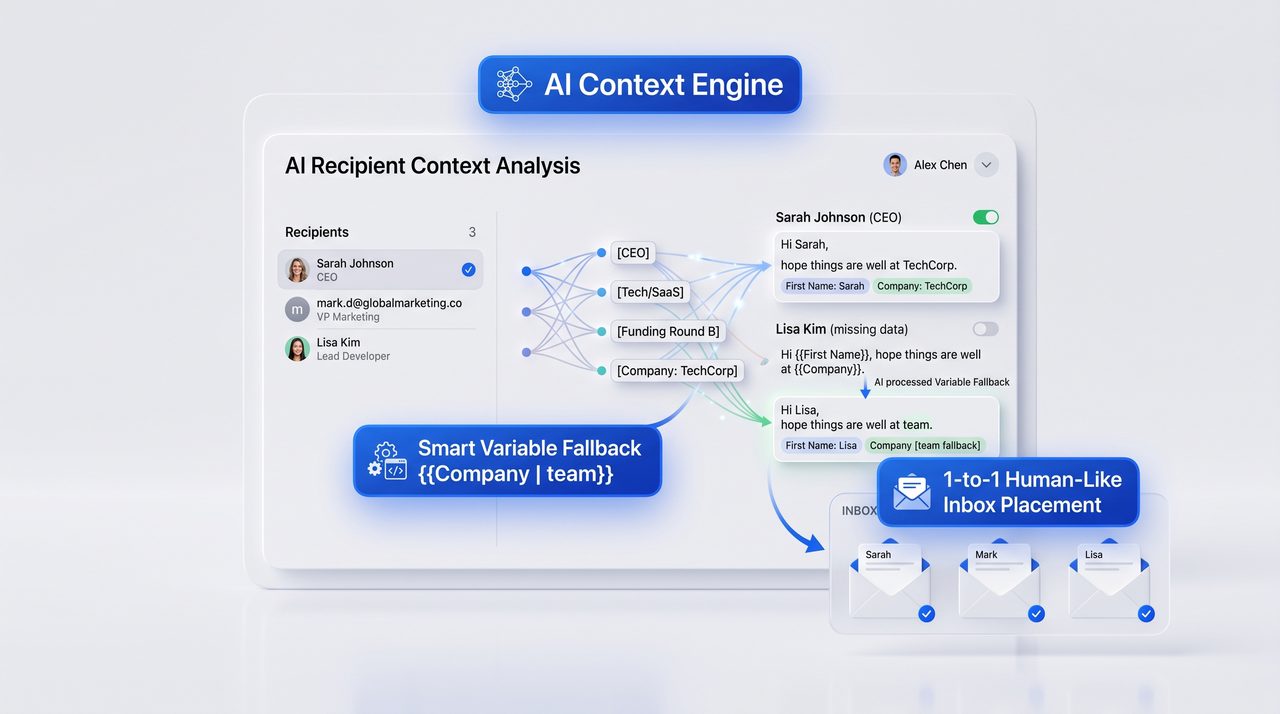
Traditional email personalization relied on rigid database fields—inserting {{First Name}} or {{Company}} into a boilerplate template. Today, AI models synthesize multiple external data points to construct contextual relevance.
| Era | Outreach Mechanism | Personalization Level | Typical Response Rate |
|---|---|---|---|
| Era 1: Broadcast | Bulk Mailers (Mailchimp, raw SMTP) | None (Generic blast) | < 1% |
| Era 2: Rule-Based Merge | CSV Merge Tags ({{Company}}, {{City}}) |
Surface-level substitution | 2% – 5% |
| Era 3: Contextual AI | Multimodal LLM synthesis (News, tech stack, job changes) | Contextual pain-point alignment | 8% – 18%+ |
[Raw Prospect Data] ──> [LLM Context Engine] ──> [Dynamic Variable Rows] ──> [Human Review / Dispatch]
(Tech Stack, Job Posts, (Identifies bottleneck   (Populates contextual       (Verifies tone & accuracy
 Company News)           & value proposition)    snippets & fallbacks)       in SendGM)
Modern Personalization in Practice
Instead of generic compliments, AI workflows analyze operational signals:
- Hiring Patterns: Detecting open engineering roles to pitch developer tooling.
- Tech Stack Detection: Identifying obsolete frameworks to offer migration services.
- Executive Statements: Referencing specific insights from a founder’s recent podcast or quarterly update.
2. AI-Powered Inbox Defense: How Inboxes Spot Robotic Spam
Email providers no longer rely solely on simple keyword blacklists or static IP blocklists. Modern anti-spam engines use deep learning and natural language processing to evaluate incoming email intent:
1. Syntactic & Semantic Pattern Recognition
When an automated bot sends 500 variations of an email with identical sentence structures and minor synonym swaps, inbox classifiers recognize the underlying semantic fingerprint. If hundreds of accounts receive identical pitch frameworks simultaneously, the sender domain is throttled.
2. Behavioral Engagement Scoring
Algorithms evaluate real-time recipient reactions:
- Do recipients read the full email or archive it within 1 second?
- Do recipients mark the email as spam or move it to folders?
- Is there an authentic two-way conversation, or is it a one-sided dead end?
3. The Demise of Unattended Auto-Senders
Fully autonomous “set-and-forget” bots that blast thousands of AI-written emails without human validation suffer rapid deliverability degradation. Inboxes prioritize authentic, interactive correspondence over automated bulk relays.
3. The “Human-in-the-Loop” Advantage
As inboxes become more skeptical of automated volume, high-performing sales teams and founders are adopting a Hybrid Human-in-the-Loop (HITL) framework.
┌────────────────────────────────────────────────────────┐
│ 1. AI Data Preparation (Batch enrichment & drafting)   │
├────────────────────────────────────────────────────────┤
│ 2. Smart Dynamic Fallbacks (Syntax error prevention)   │
├────────────────────────────────────────────────────────┤
│ 3. Human Quality Control (Tone & relevance validation) │
├────────────────────────────────────────────────────────┤
│ 4. Native Browser Dispatch (1-to-1 Gmail execution)    │
└────────────────────────────────────────────────────────┘
Why Human Verification Remains Essential
- Eliminating AI Hallucinations: Language models frequently misinterpret niche technical roles, hallucinate business models, or produce overly sycophantic opening lines that damage credibility.
- Preserving Brand Trust: A single awkward automated phrase can burn a relationship with a high-value enterprise prospect.
- Interactive Control: Tools like SendGM allow senders to leverage AI-generated CSV data while reviewing and launching individual compose sessions directly within native Gmail, maintaining total oversight before any message leaves the outbox.
4. Plain-Text Superiority in an AI Ecosystem
Heavy HTML templates, tracking wrappers, and third-party relay servers add technical baggage that AI filters flag as promotional marketing.
- Clean Message Headers: Messages initiated directly via native browser URI protocols carry authentic Google authentication headers (SPF, DKIM, DMARC) with zero third-party bulk tags (
List-Unsubscribe,X-Campaign-ID). - Mobile-First Readability: Short, plain-text emails (50–100 words) mirror organic internal communication between colleagues, bypassing the Promotions tab and landing in the Primary Inbox.
- Zero Script Bloat: Client-side execution ensures your contact lists remain inside local browser memory rather than synced to unverified cloud databases.
5. Strategic Predictions for the Next Wave of Email Outreach
- Smaller Lists, Higher Yields: The era of scraping 50,000 emails and blasting them at a 0.5% conversion rate is over. Winning teams will target 200–500 hyper-vetted prospects with surgical relevance.
- Dynamic Fallbacks as Core Infrastructure: As data lists become more variable, fallback syntax (e.g.,
{{First Name|there}}or{{Company|your team}}) prevents broken AI outputs from ever reaching production. - Intent-Triggered Dispatch: Outreach will shift from calendar-based schedules to event-driven triggers (e.g., responding within hours of a funding disclosure or executive leadership change).
Frequently Asked Questions
Will AI replace human copywriters in cold outreach?
AI replaces the manual grunt work of data aggregation, initial outlining, and first-draft generation. However, human intuition, tone refinement, and relationship management remain essential to converting prospects into paying clients.
How do I prevent my AI-assisted emails from being flagged as spam?
Keep message lengths concise, avoid hyperbolic trigger words (“guaranteed”, “risk-free”), maintain daily volume under 50 emails per account, and send through authentic, authenticated Google Workspace or Gmail sessions rather than shared broadcast servers.
Why is client-side CSV processing important when using AI tools?
Uploading sensitive client lists and proprietary leads to third-party cloud servers introduces data leakage and privacy compliance risks. Processing your outreach client-side ensures your lead data stays securely in local browser memory.