Most cold emails get deleted within three seconds because they read like generic sales pitches. Decision-makers do not have the time to read corporate bios, multi-paragraph feature lists, or unearned requests for 30-minute calendar blocks.
High-converting cold outreach follows a lean, psychological flow designed to capture attention on mobile screens, communicate value in under 30 seconds, and make replying effortless.
1. The 4-Part High-Converting Cold Email Blueprint
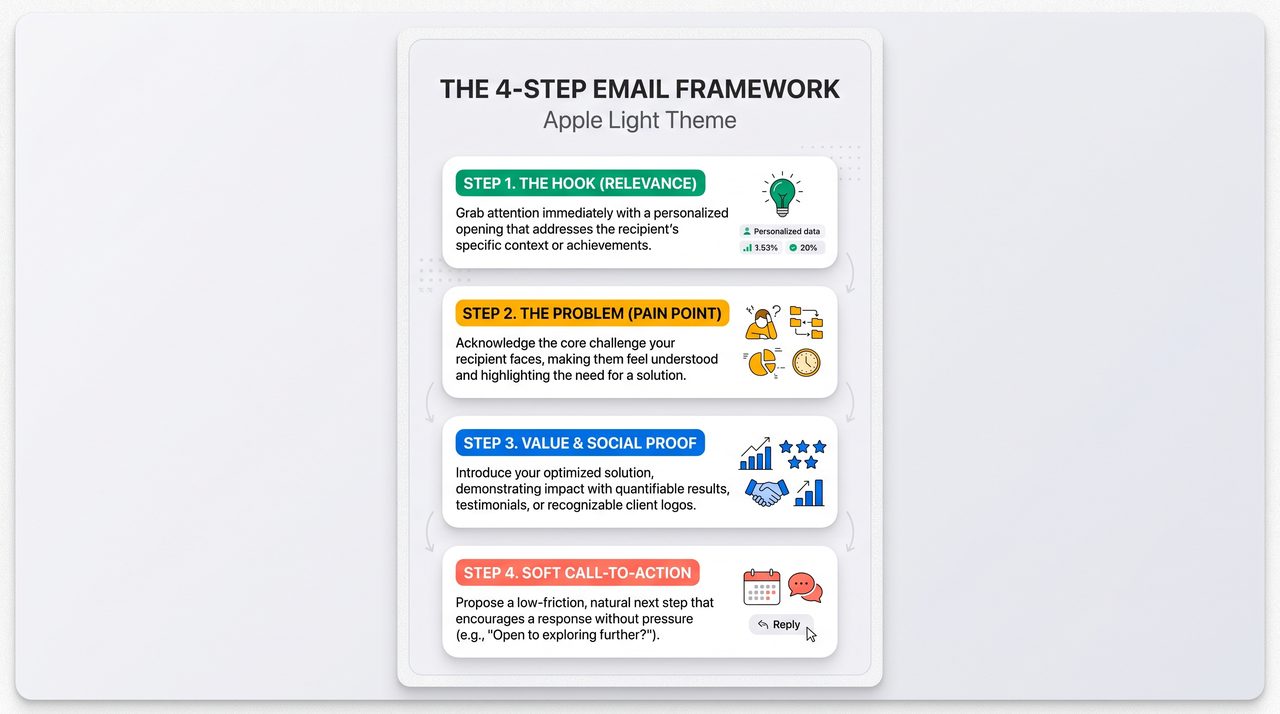
A winning cold email consists of four modular building blocks. Each sentence has one objective: earn the right to the next sentence.
┌─────────────────────────────────────────────────────────────┐
│ 1. The Hook (Context & Direct Relevance)                    │
├─────────────────────────────────────────────────────────────┤
│ 2. The Problem / Friction Point (Visceral & Specific)       │
├─────────────────────────────────────────────────────────────┤
│ 3. The Value Proposition & Social Proof (1–2 Sentences)     │
├─────────────────────────────────────────────────────────────┤
│ 4. The Soft CTA (Low Friction, Interest-Based)              │
└─────────────────────────────────────────────────────────────┘
1. The Hook (Immediate Relevance)
Ditch fake pleasantries like “I hope this email finds you well” or “My name is Alex and I work at…”. Start directly with context relevant to the recipient’s daily work or business.
- Weak: “We are an industry-leading agency providing software engineering services.”
- Strong: “Saw that {{Company}} is expanding your engineering squad this quarter.”
2. The Problem / Context
Highlight a specific operational friction point that companies of their size regularly face. When you articulate their challenge accurately, they naturally assume you have the solution.
- Weak: “Many companies struggle with managing software delivery.”
- Strong: “Most technical leads find that scaling teams quickly leads to onboarding bottlenecks and delayed sprint velocity.”
3. The Value Proposition & Proof
Explain how you solve that problem in 1–2 sentences, backed by a quantifiable outcome or brief case study. Focus strictly on the business transformation, not a laundry list of product features.
- Weak: “Our platform has 50+ integrations, automated reporting, and an AI copilot.”
- Strong: “We helped teams like {{Competitor/Peer}} cut developer onboarding cycles from 3 weeks down to 4 days.”
4. The Soft CTA (Call to Action)
Do not ask for a 30-minute meeting or paste an aggressive Calendly link in your very first email. Use an interest-based soft ask that requires minimal commitment to answer.
- Weak (High Friction): “Are you free for a 30-minute Zoom call this Thursday at 2 PM?”
- Strong (Low Friction): “Open to checking out a 90-second video overview, or should I leave it here?”
2. Length, Readability, and Visual Scannability
Over 65% of business emails are opened on mobile devices. If your message looks like a dense wall of text, it will be archived unread.
| Rule | Benchmark | Why It Matters |
|---|---|---|
| Total Word Count | 50 – 110 words | Keeps reading time under 25 seconds. |
| Paragraph Length | 1 – 2 sentences | Creates clean white space that is effortless to scan on mobile screens. |
| Links / Attachments | 0 – 1 link max | Multiple links trigger spam filters and divide the reader’s focus. |
| Formatting | Plain text / minimal formatting | Heavy HTML layouts signal broadcast marketing; plain text signals authentic personal communication. |
3. Dynamic Variables and Smart Fallback Handling
Personalization goes beyond inserting {{First Name}}. However, missing spreadsheet data can result in embarrassing mistakes like “Hi {{First Name}}” or awkward spacing.
Using dynamic fallback syntax ensures your email renders cleanly regardless of missing data:
| Variable Syntax | When CSV Value is Present | When CSV Column is Blank |
|---|---|---|
| `{{First Name | there}}` | “Hi Sarah,” |
| `{{Company | your team}}` | “…relevant to Stripe” |
| `{{Role | team lead}}` | “…as a VP of Sales” |
Using client-side tools like SendGM, dynamic variables and fallbacks are evaluated in real time in your browser, allowing you to preview how each row renders before sending.
4. Plug-and-Play Outreach Templates
Template A: The B2B SaaS / Product Recommendation
Subject: quick question regarding {{Company}}

Hi {{First Name|there}},

Noticed {{Company}} is actively scaling your outbound sales team this quarter.

When teams grow rapidly, SDRs often spend up to 40% of their day manually fixing broken lead lists instead of prospecting.

We built a browser-native workflow that automates list verification directly in Gmail, helping teams like Acme boost active outreach volume by 35%.

Open to checking out a 2-minute workflow demo, or not a priority right now?

Best,
{{Your Name}}
Template B: The Agency / Service Problem-Agitation-Solution
Subject: {{Company}}'s page speed

Hi {{First Name|there}},

Ran across {{Company}}'s homepage while auditing web performance benchmarks for {{Industry}} brands.

Your core web vitals are currently scoring around 48/100 on mobile, which usually translates to a 15–20% drop in paid ad conversions.

We recently helped {{Similar Brand}} optimize their mobile load speed down to 1.1s, lifting checkout completion by 22% within 30 days.

Would you be open to seeing a 3-point breakdown of where the bottlenecks are?

Cheers,
{{Your Name}}
5. Cold Outreach Anti-Patterns to Avoid
- ❌ Fake Thread Prefixes: Adding
Re:orFwd:to a first-touch email destroys trust and violates CAN-SPAM regulations. - ❌ Feature Dumping: Listing eight bullet points about what your product does instead of the specific metric it improves.
- ❌ Jargon-Heavy Copy: Words like “synergistic”, “paradigm-shifting”, and “revolutionary” signal a generic corporate blast.
- ❌ Calendar Links in First Touch: Pasting a booking link before establishing mutual interest assumes unearned entitlement to the prospect’s time.
Frequently Asked Questions
What is a good reply rate for B2B cold email?
A well-targeted, personalized campaign using the 4-part blueprint typically achieves a 15% to 30%+ open rate and a 5% to 12%+ reply rate. Reply rates below 3% usually indicate poor data targeting, weak relevance, or spam filter delivery issues.
Should I send follow-ups, and how many?
Yes. Over 50% of positive replies come from follow-up messages. A standard sequence contains 3 to 4 total emails spaced 3–5 days apart, with each follow-up adding a new piece of value, insight, or alternative angle rather than just asking “Did you see my last email?”.
Does plain-text email really outperform designed HTML templates?
For direct 1-to-1 B2B outreach, yes. Plain-text emails bypass Gmail’s automated Promotions tab algorithms and feel like authentic, personal messages from a real person, resulting in significantly higher engagement.